AI Workforce
What Is an AI Workforce, and How Is It Different From an AI Tool Subscription?
An AI workforce goes beyond AI tool subscriptions by assigning AI workers defined roles inside business processes. Learn the five key differences and what it takes to build one.
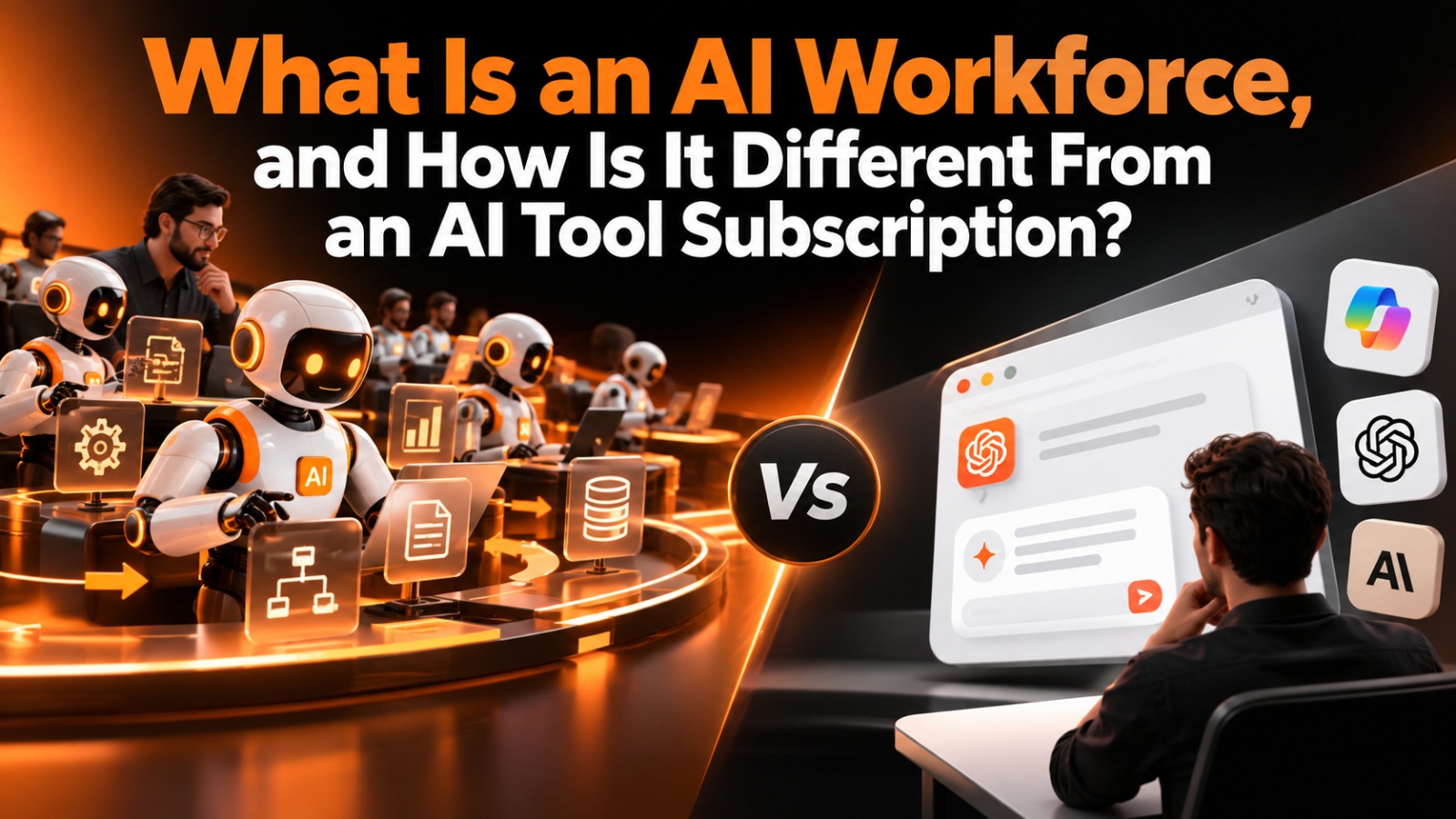
An AI workforce is a set of AI workers that hold defined jobs inside your business processes, working alongside your employees under one accountable human owner, with governance and evaluation at every step. An AI tool subscription is something different: a license that gives individual people access to a model through a vendor's interface. The first changes how work gets done. The second changes how fast one person can draft, search, or summarize.
Most enterprises already have the second. Copilot, ChatGPT, and Claude seats are in daily use, renewal conversations are underway, and adoption dashboards look healthy. Yet when a CIO is asked which business process now runs differently because of AI, the answer is often a pilot that never left the sandbox. That distance between AI activity and systems running in production is the execution gap, and buying more seats doesn't close it.
This article defines the AI workforce precisely, lays out the five differences that separate it from an AI tool subscription, and explains what a technology organization actually has to build to make the move.
Why the Distinction Matters Now
The distinction matters because the two are budgeted, measured, and governed in completely different ways, and treating one like the other produces stalled programs. When AI is bought as a subscription, it lands in the software line, gets measured by active users, and is owned by whoever manages the license. When AI is deployed as a workforce, it lands against a business process, gets measured by what that process produces, and is owned by a named leader who answers for the outcome.
Many organizations have spent the last two years on the subscription model and are now asking the harder question: what has materially changed? The honest answer, in most cases, is that individuals are more productive and the operating model is untouched. That isn't a failure of the tools. It's a category error about what the tools were ever designed to do.
What an AI Workforce Is (and What It Isn't)
An AI workforce is made up of AI workers, and an AI worker is the third level on a simple maturity ladder. A chatbot answers when asked. An AI agent completes a specific task. An AI worker holds a job: it has a job description, end-to-end responsibility for a defined piece of work, access to the systems that work requires, and a human manager. We cover the three levels in depth in Chatbot vs. AI Agent vs. AI Worker: What's the Difference?
An AI workforce isn't a replacement for your people, and it isn't a collection of chatbots with better prompts. It's a hybrid workforce: employees and AI workers operating across one shared business process. A typical flow looks like this. AI workers intake and triage the request. An employee reviews the exceptions. AI workers gather the data and draft the work. An employee makes the decision and approves it. AI workers execute in the systems of record. One accountable human owner sits over the whole flow.
A subscription, by contrast, sits beside the process rather than inside it. Someone opens a window, asks a question, copies the answer somewhere else, and the process itself carries on exactly as it did before.
The Five Differences Between an AI Workforce and an AI Tool Subscription
The clearest way to compare an AI workforce with an AI tool subscription is to look at five things: what you buy, who starts the work, where it runs, how it's measured, and who's accountable. Each difference is independent, and each one on its own is enough to explain why seat-based AI rarely shows up in business results.
The unit you buy: a seat versus a role. A subscription is priced and planned per person. You decide how many employees get access, and value depends on each of them choosing to use it well. An AI workforce is planned per role. You decide which job in which process an AI worker will hold, write the job description, and define the output it's responsible for. The planning conversation shifts from "how many licenses" to "which work, owned by whom."
Who starts the work: a person prompting versus a worker holding the job. A tool waits for someone to ask. Every unit of value requires a human to remember it exists, frame a good request, and act on the result. An AI worker is triggered by the process itself: a new ticket, a new contract, a new inbound request. It picks up the work because the work is its job, and it escalates to a human when a decision falls outside its defined scope.
Where it runs: inside the vendor's interface versus inside your environment. A subscription runs within the vendor's application boundary, with whatever integrations that vendor chooses to support. An AI workforce runs inside your own environment, on your cloud, against your data architecture, under your identity and security controls. It reads from and writes to your systems of record with scoped permissions, which is what lets it do real work rather than produce text someone else has to move.
How it's measured: adoption versus business outcome. Subscriptions are measured by activity: active users, prompts sent, hours saved on self-reported surveys. Those numbers describe usage, not impact. An AI workforce is measured the way the process it serves is measured: cycle time, throughput, quality, error rates, and the business result the process exists to produce. If the process doesn't get measurably better, the AI worker isn't doing its job.
Who's accountable: everyone and no one versus one accountable human owner. With a subscription, accountability is spread across every user, which in practice means nobody owns the outcome. An AI workforce has one accountable human owner for each process, plus defined evaluation and governance at every step: what the worker may access, what it may decide alone, what requires approval, and how its performance is reviewed over time.
Why AI Tool Subscriptions Stall at Level One
AI tool subscriptions stall at level one of the maturity ladder because they were built for individual productivity, not for owning work inside a process. Even the most capable model, accessed through a chat window, is still a chatbot: reactive, disconnected from systems of record, and dependent on a person to carry every output to where it matters.
Capability isn't the constraint. The same underlying models that power a subscription can power an AI worker. What's missing is everything around the model that turns it into a system that can be trusted with a job. That's why a strong model on a paid seat and a governed AI worker in production can use the same engine and produce completely different business results.
There's also a structural reason. Subscriptions are purchased centrally but used individually, so no single team is accountable for turning them into process change. The license owner manages cost and access. The business leader never asked for a tool and isn't measured on its use. The work that would connect the two, choosing a process, redesigning it, integrating the systems, and governing the result, belongs to nobody. That's the execution gap in its most common form.
What It Takes to Build an AI Workforce
Building an AI workforce takes a set of engineering foundations that a subscription never requires, because an AI worker has to operate reliably inside your systems rather than beside them. The model choice matters less than most buyers expect. The foundations matter more.
Knowledge systems. An AI worker needs governed access to the company knowledge its job depends on: policies, product information, process documentation, prior decisions. Without it, the worker guesses or asks, and neither scales.
Memory and agent data infrastructure. A worker that holds a job has to remember context across cases and over time, and it needs its own place to store working data and files. Stateless chat sessions can't hold a job.
Skills. Reusable, centrally managed capabilities, such as reading a contract, reconciling a record, or drafting a response to a defined standard, let workers perform consistently and let the organization improve a capability once and apply it everywhere.
Identity and permissions. Every AI worker needs an identity in your environment, with scoped access to the systems its role requires and nothing more. This is where security and IT leadership earn trust in the program.
Orchestration. Real processes involve handoffs between AI workers, employees, and systems. Orchestration defines who does what, in what order, and what happens when something falls outside the expected path.
Evaluation and governance. Before an AI worker goes live, you need a way to test its output against a standard, monitor it in production, and decide what it may do alone versus what needs human approval. This is the layer that makes an AI workforce defensible to risk, compliance, and the board.
None of these foundations lock you into a particular cloud or model provider. They're method, not infrastructure, and they can be built on Azure, AWS, Google Cloud, or whatever stack you already run, with whichever models your organization has approved.
Do You Still Need the Subscriptions?
Yes, in most cases you do. AI tool subscriptions are a sensible way to raise individual productivity, build familiarity with AI across the workforce, and surface ideas about where AI could create value. Many of the strongest AI worker use cases start as a pattern someone noticed while using a chatbot.
The mistake is expecting subscriptions to do a job they weren't designed for. Seats give people a better tool. An AI workforce gives a business process a new kind of worker. Most enterprises will run both for the foreseeable future, and the useful question isn't which one to choose but which processes are ready to move from level one to level three.
Putting It Together: From Seats to Roles
The move from an AI tool subscription to an AI workforce is a move from planning in seats to planning in roles. It starts with a business priority rather than a license count, picks one or two processes where an AI worker could hold a defined job, builds the foundations that let that worker operate inside your environment, and measures the result against the process it serves.
The five differences give a practical test for any AI initiative on your roadmap. Is it bought as a seat or designed as a role? Does it wait for a prompt or hold the work? Does it run in the vendor's interface or in your environment? Is it measured by usage or by outcome? Is there one accountable human owner? An initiative that answers "role, holds the work, your environment, outcome, one owner" is building an AI workforce. Anything else is still a subscription, however advanced the model behind it.
For a broader view of how the hybrid workforce, the maturity ladder, and readiness fit together, see AI Workforce Strategy: The 4 Pillars That Close the Enterprise AI Execution Gap. If you're weighing whether your organization can support that shift today, How Do You Know If Your Organization Is Ready for AI? walks through the signals that matter.
Where This Leaves You
If your AI program today is mostly seats, you're in good company, and you're also at the starting line rather than the finish. The organizations that pull ahead won't be the ones with the most licenses. They'll be the ones that pick a real process, give an AI worker a defined job inside it, and prove the result in their own environment before committing to scale.
We'd rather start that conversation with your priorities than with a product. What does your organization need AI to materially change in the next 12 months? Talk to us.
Frequently Asked Questions
What is an AI workforce?
An AI workforce is a group of AI workers that hold defined jobs inside business processes, working alongside employees in a hybrid workforce. Each AI worker has a job description, end-to-end responsibility for a piece of work, scoped access to the systems it needs, and a human manager. The whole process sits under one accountable human owner, with governance and evaluation at every step.
What is the difference between an AI workforce and AI tools?
AI tools, such as chatbot and copilot subscriptions, give individual people access to a model and wait for them to ask. An AI workforce assigns AI workers to roles inside a business process, where they pick up work as it arrives and act in your systems of record. Tools are measured by adoption. An AI workforce is measured by what the process produces.
Is Microsoft Copilot or ChatGPT Enterprise an AI workforce?
On their own, no. Enterprise chatbot and copilot licenses are level one on the maturity ladder: reactive tools that answer when a person asks. The same underlying models can power AI workers, but only once they're given a defined role, access to systems of record, memory, permissions, orchestration, and evaluation inside your environment.
How do you move from AI tool subscriptions to an AI workforce?
Start with a business priority rather than a license count, and pick one or two processes where an AI worker could hold a defined job. Build the foundations that let that worker operate inside your environment, assign one accountable human owner, and prove the result against the process's own metrics before scaling. Keep the subscriptions for individual productivity while you do it.