AI Meeting Notetaker
Best AI Notetakers for AI-First Teams
The best AI notetakers for AI-first teams, compared: Scribe, Otter, Fireflies, Fathom, Granola and more, judged on memory, actions, agent access and governance.
The best AI notetakers in 2026 all transcribe well. That's no longer the hard part. For an AI-first team, the real question is what happens to a meeting after it ends: does the decision become an owned action in Jira, does the context become something an agent can query next quarter, and does any of it respect the access controls your security team signed off on?
Most enterprises already have a notetaker, often several. Someone in sales bought one, the product team uses another, and the collaboration suite ships a third by default. What they rarely have is meeting knowledge that flows into the rest of their AI systems. Decisions get made in meetings, summarized into an inbox, and lost. That's a small version of the execution gap: the insight existed, but nothing was accountable for carrying it into production.
This guide is written for CIOs, CTOs, and AI leaders choosing an AI meeting notetaker for the enterprise. It covers what changes when your team is AI-first, five tests to apply to any tool, and how the leading options compare, including Scribe, the meeting-intelligence product we build.
What Makes an AI Notetaker Right for an AI-First Team?
An AI notetaker is right for an AI-first team when its output is an input to other systems, not just a summary for a human to read. A summary helps one person once. Structured, permissioned meeting knowledge helps every agent and workflow that comes after it.
AI-first teams already run copilots, agents, and increasingly AI workers that hold real jobs inside business processes. Those systems are only as good as the context they can reach. Meetings are where a large share of an organization's decisions, objections, commitments, and edge cases first get spoken out loud. If that knowledge stays locked in a per-meeting summary, every downstream system is working with partial context.
That shifts the evaluation criteria. Transcription accuracy and summary quality still matter, but they're table stakes. The differentiators are memory, action, access, governance, and fit with the stack you already run.
Five Tests for Choosing an Enterprise AI Notetaker
Apply these five tests to any AI meeting assistant before it goes near a production rollout. They're the same questions we ask when meeting knowledge becomes part of a larger agentic system.
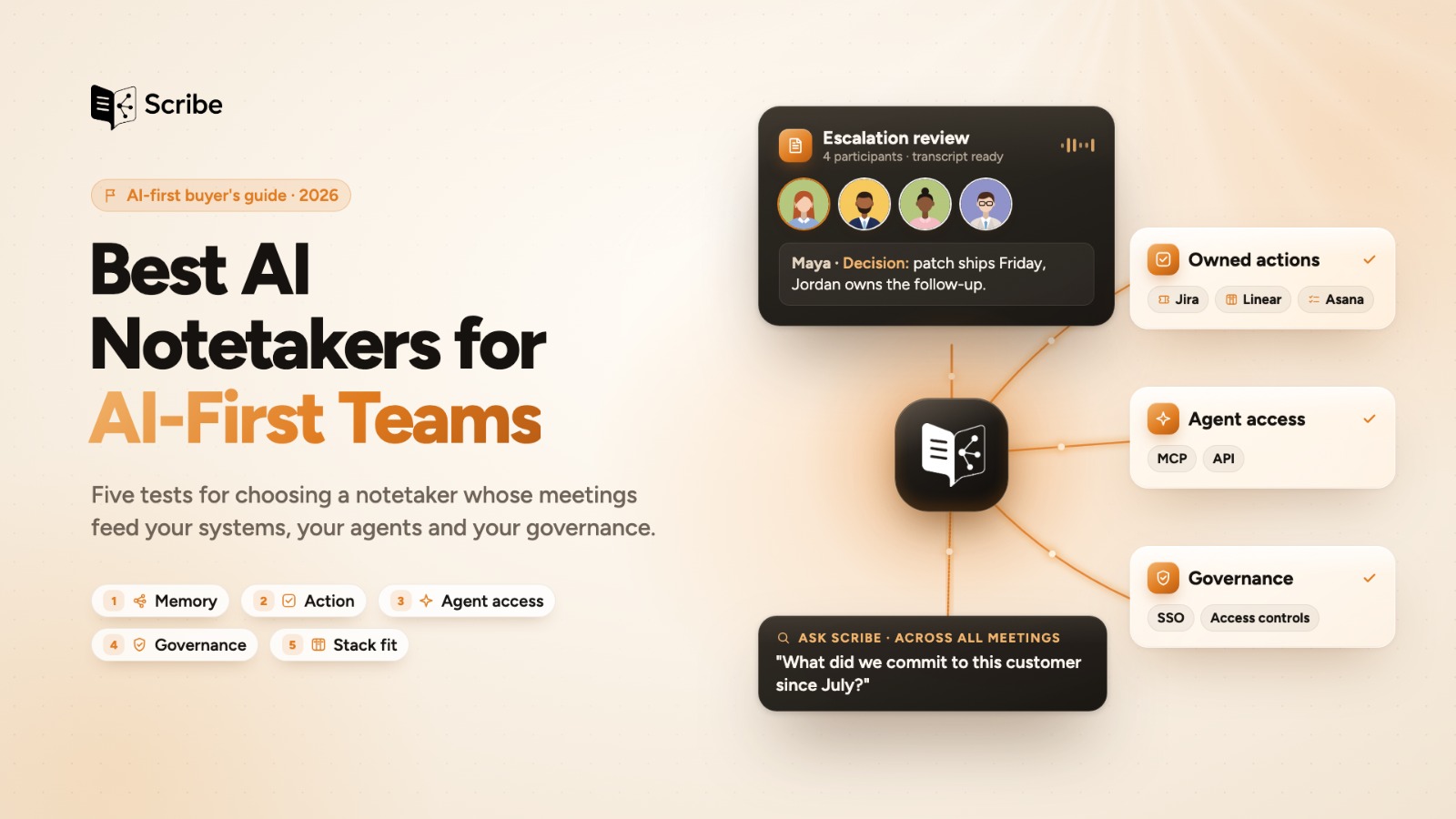
It remembers across meetings, not just within one. Ask whether you can query the full history in plain language, such as "what did we commit to this customer since July," and get an answer grounded in the source meetings. Per-meeting summaries don't compound. Cross-meeting memory does.
It turns decisions into owned actions in your systems of record. Action items should carry an owner, an open or done status, and a link back to the meeting they came from, and they should land in Jira, Linear, or Asana rather than a recap email. One accountable human owner per action is the difference between a note and a commitment.
It exposes meeting knowledge to your agents. An AI-first team needs programmatic access through an API and, increasingly, the Model Context Protocol (MCP), so agents and AI workers can read meeting context with the same permissions a person would have.
It meets your governance bar. Look for access controls on the shared meeting library, SSO and provisioning, clear retention and deletion settings, recording consent behavior that legal has reviewed, and a vendor security posture you can verify. Meeting content is some of the most sensitive data a company produces.
It fits the stack and the way your people meet. Check coverage for the conferencing platforms you actually use, whether it joins as a visible bot or captures audio from the device, how it handles in-person meetings, and whether it can be branded or white-labeled for client-facing calls. You choose the stack. The notetaker should adapt to it.
The Best AI Notetakers in 2026, Compared
Every tool below is a credible choice for the right team. The differences show up in which of the five tests each one was built to pass. Feature sets in this category change quickly, so verify current capabilities and security documentation with each vendor before you decide.
Scribe: best for teams that want meeting knowledge to feed their AI systems. Scribe is built around institutional memory rather than individual recaps. Ask Scribe answers plain-language questions across your past meetings. Action items carry owners and open or done status linked to the source meeting, and they push to Linear, Asana, or Jira. Calendar sync auto-joins eligible meetings, Send Scribe handles ad hoc links, and Record captures in-person conversations on desktop or mobile. Meetings live in a shared, searchable library with access controls, the bot's name, introduction, and branding are customizable, and MCP and API access let your agents use meeting context directly.
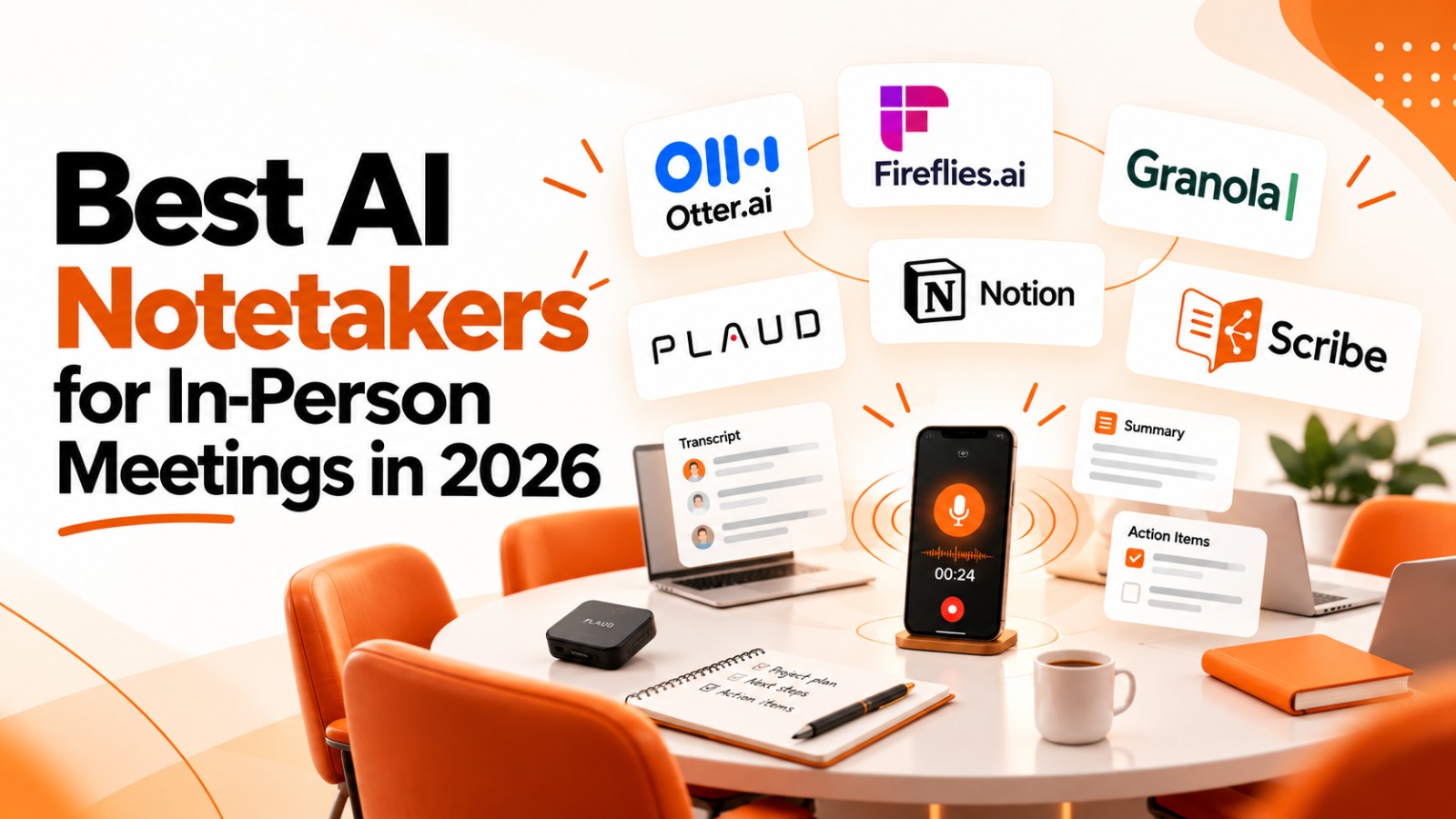
Otter.ai: best for live transcription and a long-standing searchable archive. Otter has one of the longest track records in the category, with real-time transcription, a searchable meeting archive, and enterprise controls such as SSO and SCIM on its higher tiers. It's a familiar choice when live captions and broad adoption matter most.
Fireflies.ai: best for integration breadth and multilingual teams. Fireflies connects to a wide range of CRMs, project tools, and automation platforms, supports many languages, and offers cross-meeting Q&A. It suits organizations with high meeting volume spread across many tools.
Fathom: best for fast, sales-oriented summaries. Fathom is known for quick post-call summaries and CRM syncing, with SSO, SCIM, and custom retention at its enterprise tier. Revenue teams that live in HubSpot or Salesforce tend to adopt it quickly.
Granola: best for people who want an AI notetaker without a bot. Granola captures audio from the device instead of joining the call, and it blends your own rough notes with the transcript. Its business tier adds integrations plus API and MCP support. It's strongest for individual note quality, with team-wide memory as a secondary use.
Fellow: best for structured meeting operations. Fellow is built around agendas, recurring meetings, and action-item hygiene, with recording and AI notes layered on top. It fits organizations that want to fix how meetings are run, not only how they're recorded.
Built-in suite assistants: best when convenience outweighs portability. Microsoft Copilot in Teams, Zoom AI Companion, and Gemini in Google Meet are already inside licenses many enterprises pay for. They're the lowest-friction start, but their knowledge tends to stay inside one vendor's ecosystem, which matters if your agents run elsewhere or your teams meet across platforms.
Why We Built Scribe Around Institutional Memory
We built Scribe because the meeting-notes problem we kept running into inside enterprise engagements wasn't a transcription problem. It was a memory problem. Teams had transcripts. What they didn't have was a reliable way to ask "why did we decide that" six weeks later, or to give an agent the context behind a customer commitment without forwarding a pile of recordings.
So Scribe is meeting intelligence first and notetaker second. It's one of the infrastructure pieces we bring into engagements when it makes delivery faster, next to governed company knowledge and agent memory, and it's built to work with your models, your cloud, and your systems of record rather than replace them. If you already have a notetaker your people like, the test isn't whether Scribe takes better notes. It's whether your meeting knowledge is reaching the systems that need it.
How to Match a Notetaker to Your AI Maturity
The right AI notetaker depends on where your organization sits on the maturity ladder. A notetaker that only summarizes on request behaves like a chatbot. One that extracts action items and pushes them into a tracker behaves like an agent, designed for a task. Meeting intelligence that holds the job of capturing, organizing, and serving institutional knowledge to the rest of the business starts to look like an AI worker. We break down those three levels in Chatbot vs. AI Agent vs. AI Worker: What's the Difference?
If you're early, a built-in suite assistant or a well-liked individual tool is a reasonable start. If you're running agents in production, or planning a hybrid workforce where AI workers and employees share one process, the API, MCP, permissions, and cross-meeting memory tests move to the top of the list. That's the point where a notetaker stops being a productivity app and becomes part of your architecture.
Bringing It Together
Choosing among the best AI notetakers comes down to one question: where should meeting knowledge go after the call ends? For individual productivity, almost any tool on this list will do. For an AI-first team, the answer has to include your systems of record, your agents, and a governance model that one accountable human owner can stand behind.
Start small. Pick one team and one process where lost meeting context costs you something real, such as customer escalations, architecture decisions, or deal handoffs. Prove the value in your own environment, then scale with evidence. It's the same pattern we use for every AI initiative, and it's why enterprises don't have an AI idea problem, they have an execution problem.
What does your organization need AI to materially change in the next 12 months? Talk to us.
Frequently Asked Questions
What is the best AI notetaker for enterprise teams?
The best AI notetaker for an enterprise team is the one that passes five tests: memory across meetings, owned actions in systems of record, agent access through an API or MCP, governance your security team accepts, and fit with your existing stack. Scribe is built for teams that want meeting knowledge to feed their AI systems, while tools like Otter.ai, Fireflies.ai, Fathom, and Granola each lead in narrower areas such as live transcription, integration breadth, sales summaries, or botless capture.
What's the difference between an AI notetaker and meeting intelligence?
An AI notetaker records a meeting and produces a transcript and summary for the people who attended. Meeting intelligence treats meetings as a source of institutional knowledge, connecting decisions, owners, and context across many meetings and making them available to other people, tools, and agents. The first helps one person catch up. The second helps an organization remember.
Can AI agents access meeting notes from an AI notetaker?
Yes, if the notetaker offers programmatic access through an API or the Model Context Protocol (MCP). That lets agents and AI workers query meeting context directly, ideally under the same access controls that apply to human users. Without it, meeting knowledge stays siloed and agents work with partial context.
Do you need a separate AI notetaker if you already use Copilot, Zoom AI Companion, or Gemini?
Not always. Built-in assistants are a sensible starting point and are often already licensed. A dedicated tool becomes worth it when teams meet across multiple platforms, when meeting knowledge needs to reach agents or systems outside one vendor's ecosystem, or when you need cross-meeting memory and action tracking tied to tools like Jira, Linear, or Asana.