AI Worker
AI Writing Tool vs. AI Content Worker: What's the Actual Difference?
Discover five key differences between writing tools and AI content workers, and what it takes to automate the work beyond writing.
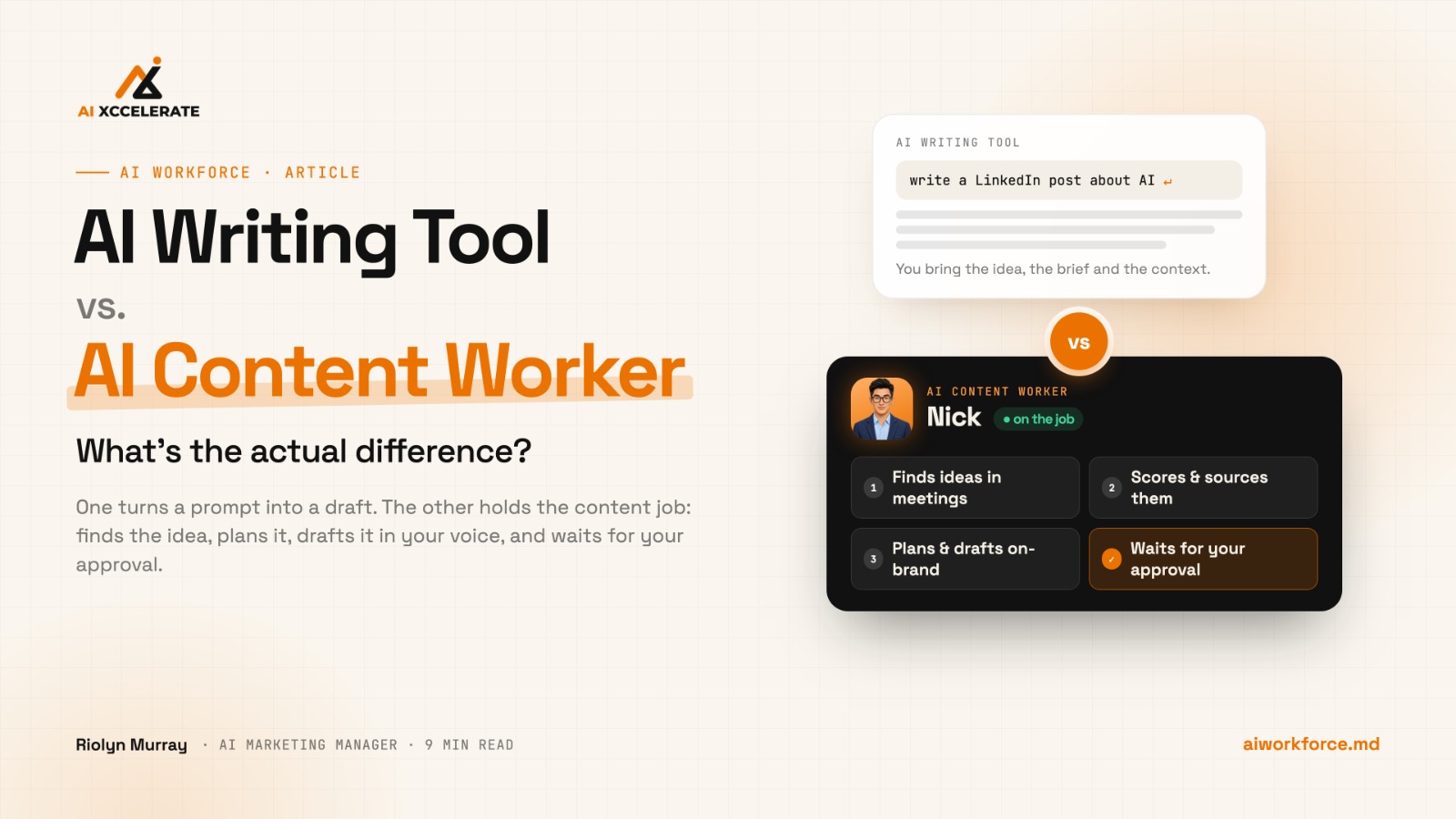
An AI writing tool turns a prompt into a draft. An AI content worker holds the content job itself: it finds what's worth saying, plans it, drafts it in your voice, and hands it to a human for approval. The model underneath can be identical. What's different is who owns the work.
That difference sounds like semantics until you look at where content marketing actually gets stuck. Most teams don't struggle to produce words anymore. ChatGPT, Claude, Jasper and a dozen others can write a decent LinkedIn post in seconds. The struggle is everything around the words: deciding what to write about, getting the context right every single time, and making sure what goes out sounds like the company and says something true.
This article breaks down what separates the two, where writing tools are genuinely the right choice, and what it takes for AI to hold the content job rather than just help with it.
Why the Distinction Matters Now
Content teams have more AI than ever and, in many cases, the same problem they started with. A blank page on Monday morning. A founder who needs to "post more." A backlog of sales calls full of insight that nobody has time to rewatch.
Writing tools made the drafting step faster. They didn't change the shape of the job. Someone still has to find the idea, brief the tool, explain the brand, check the output and move it into the next step. In practice, many marketers now spend their AI time doing exactly that: re-explaining who they are to a chat window, then rewriting what comes back so it sounds less generic.
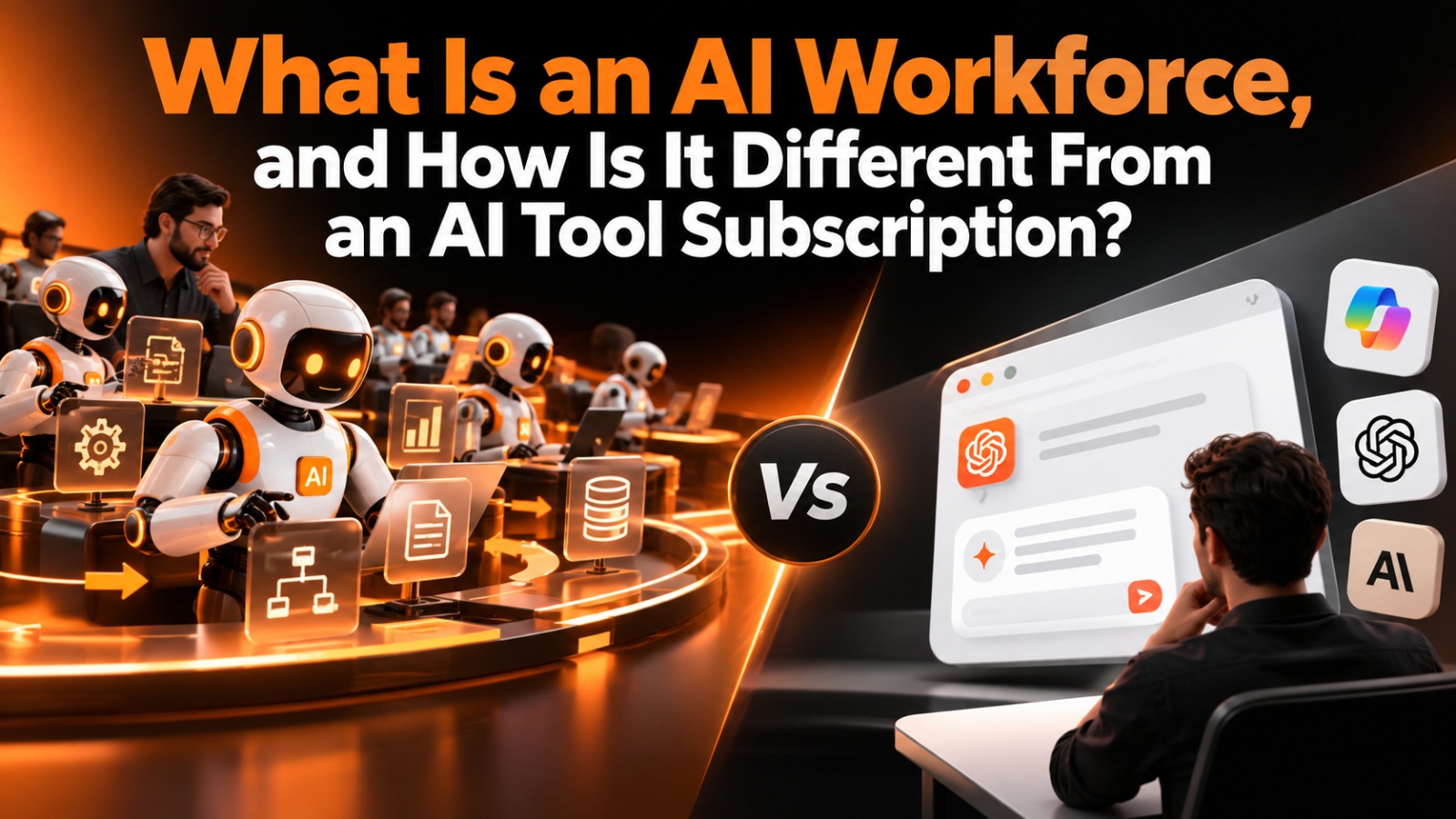
This is the same pattern we described in What Is an AI Workforce, and How Is It Different From an AI Tool Subscription?. A subscription gives a person access to a model. It sits beside the process. A worker sits inside it.
What an AI Writing Tool Is (and What It's Good At)
An AI writing tool is software that generates or edits text on request. You bring the topic, the brief and the context. It brings speed and fluency.
The category is broad, and the best tools in it are genuinely good:
General assistants (ChatGPT, Claude, Gemini). The most flexible option. Excellent for quick drafts, rewrites, brainstorming and one-off pieces, as long as you supply the context.
Marketing writing platforms (Jasper, Writer). Built for teams producing brand-consistent content at scale, with brand voice settings, templates and style guides.
SEO-led tools (Surfer, Frase, Writesonic). Optimise content around search demand, scoring drafts against what ranks or what AI search engines cite.
Transcript-to-post tools and workflows. Newer tools and DIY automations that turn a call transcript into a LinkedIn post, often by pasting the transcript into a model or wiring one up with an automation tool.
If you know exactly what you want to say and you just need it written faster, a writing tool is often the right answer. We use them ourselves.
What an AI Content Worker Is
An AI content worker is a named role that owns the content job end to end. It doesn't wait for a prompt. It's triggered by the work itself, works from the company's own context, and reports to a human who approves what ships.
On our workers page, we describe every AI worker the same way a company describes a hire: a job description agreed before day one, covering purpose, responsibilities, boundaries, knowledge, tools, a human manager, measures and exceptions. That framing is the point. You don't "use" a worker the way you use a tool. You give it a job.
Nick, our AI content marketer, is built that way. His job is to turn the conversations a company already has into content worth publishing:
He reads the meetings that Scribe captures, plus anything the team hands him: files, public URLs or pasted notes.
He surfaces content ideas, each one scored, tagged by persona and funnel stage, and linked to the exact meeting it came from.
Once a human approves an idea, he plans it, choosing the angle, voice and channels, and drafts it for LinkedIn, blog, newsletter or video scripts.
Nothing moves forward, and nothing ships, until someone on the team approves it.
The Five Differences Between an AI Writing Tool and an AI Content Worker
Where the work starts. A writing tool starts from a prompt you write. A content worker starts from your business: meeting transcripts, documents, notes. Instead of "write a post about AI agents," the starting point is something a customer actually said on Tuesday's call.
Who decides what's worth writing. Writing tools generate whatever you ask for. A content worker does the triage first. Nick scores every idea on the same five checks (how strongly the source supports it, audience fit, specificity, commercial usefulness and distinctiveness), so a 9 means the same thing every time, and weak ideas never reach the team at all.
Where the context lives. With a writing tool, context lives in your prompt, which means you rebuild it every session. A content worker reads from a shared knowledge base that's set up once: your ICP, personas, products, proof points, brand voice, and even the phrases your brand never uses. Every draft starts from there.
How trust is built. A writing tool gives you text and leaves verification to you. A content worker shows its work. Every idea Nick surfaces links back to a verbatim quote from the source meeting, and if no real quote supports an idea, it doesn't ship. That's a design choice, not a prompt instruction. The rules that matter (minimum scores, idea limits, quote requirements) are enforced in code.
Where the human sits. With a writing tool, the human is the operator: prompting, checking, copying, pasting, moving work along. With a content worker, the human is the manager. They review, approve, edit and decide. The production work happens without them, and the judgment stays with them.
Why Writing Tools Stall at "Faster Drafts"
The pattern is familiar to most content teams that adopted AI early. First it feels like magic. Then everything starts to sound the same. Then you notice you're spending more time correcting AI drafts than you used to spend writing them.
None of that is the model's fault. A blank prompt has to guess at everything: your audience, your tone, what you can prove, what you'd never say. And because the tool only sees what you paste in, the best raw material your company has, the conversations happening on sales calls, demos and founder syncs, usually never reaches it.
So the tool gets faster and the job stays the same size. The bottleneck simply moves from writing to briefing and editing.
Do You Still Need Writing Tools?
Yes, probably. Most teams will run both, the same way most companies keep their AI subscriptions while they build an AI workforce.
A rough way to split it:
Use a writing tool when you already know the idea, the angle and the audience, and you need something drafted, rewritten or polished quickly.
Use a content worker when the hard part is the job itself: keeping a steady pipeline of ideas grounded in what your business actually says, on brand, across channels, with a clear approval trail.
If your content calendar is full and your problem is speed, a writing tool may be all you need. If your problem is that the calendar is empty on Monday and the best ideas are buried in last week's calls, you're looking for a worker.
What It Takes for AI to Hold the Content Job
Turning a writing assistant into something that can own the job takes more than a better prompt. In building Nick, a few foundations mattered most:
A real source of truth for ideas. Meeting capture through Scribe, plus documents and notes, so ideas come from the business rather than from the model's imagination.
Shared company knowledge. One knowledge base that every stage reads from, so nobody has to explain the brand twice.
Narrow jobs inside the job. Nick is three agents (Idea, Plan and Write), each with one responsibility and a strict output format. Smaller jobs are easier to test and easier to trust.
Grounding and guardrails. Verbatim source quotes, scores that mean the same thing every run, and policies enforced in code rather than hoped for in a prompt.
A human between every step. Approve, assign or reject at the idea stage, then again at the draft stage. Every version kept.
Notice that none of these are about writing quality. The writing was never the hard part.
Where This Leaves You
The question isn't whether AI can write your content. It can. The question is whether you want AI to help you do the content job, or to hold it.
A writing tool makes the person doing the job faster. An AI content worker gives that person a teammate who already did the first 80 percent: found the idea in last week's call, scored it, planned it and drafted it in your voice, and is now waiting for a yes.
If that second picture sounds closer to what your team needs, meet Nick or start a trial at nick.aiworkforce.md. And if you'd rather think it through first, we're happy to start with your priorities rather than a product. Talk to us.
Frequently Asked Questions
What is the difference between an AI writing tool and an AI content worker? An AI writing tool generates text when you prompt it, using the context you provide. An AI content worker owns the content job: it finds ideas in your company's own sources, works from a shared knowledge base, plans and drafts across channels, and routes everything through human approval.
Is ChatGPT an AI content worker? On its own, no. ChatGPT is a highly capable general assistant, and it can power parts of a content workflow. But without a defined job, a persistent company context, grounded sources and an approval process, it behaves like a writing tool: it does what you ask, when you ask.
Can an AI content worker replace a content marketer? That's not what it's designed for. An AI content worker takes on the production work (finding, scoring, planning and drafting), so content marketers can spend their time on judgment: deciding what's worth saying, shaping the story and approving what goes out.
How does an AI content worker keep content on brand? It writes from a knowledge base the company sets up once, including audience, personas, products, proof points, named tones of voice and forbidden phrases, rather than from a fresh prompt each time. Human approval at each step catches anything that still isn't right.
Related articles