AI Worker
What Can an AI Worker Actually Do in 2026, and What It Shouldn't
What AI workers can really do in 2026 across content, outbound, inbound, sales engineering and customer success, and the jobs they should hand to a person.
Ask a room of founders what AI can do for their business and you'll usually hear two answers.
The first group has tried a few tools, got some decent drafts and decided AI is a nice extra. They'd never let it near a customer. The second group has watched the demos and believes AI can run their whole sales team by Friday. They'd let it do almost anything.
Both groups are wrong, and in the same way. They're asking what AI can do. The better question is which jobs it should own, and where a person has to stay in charge.
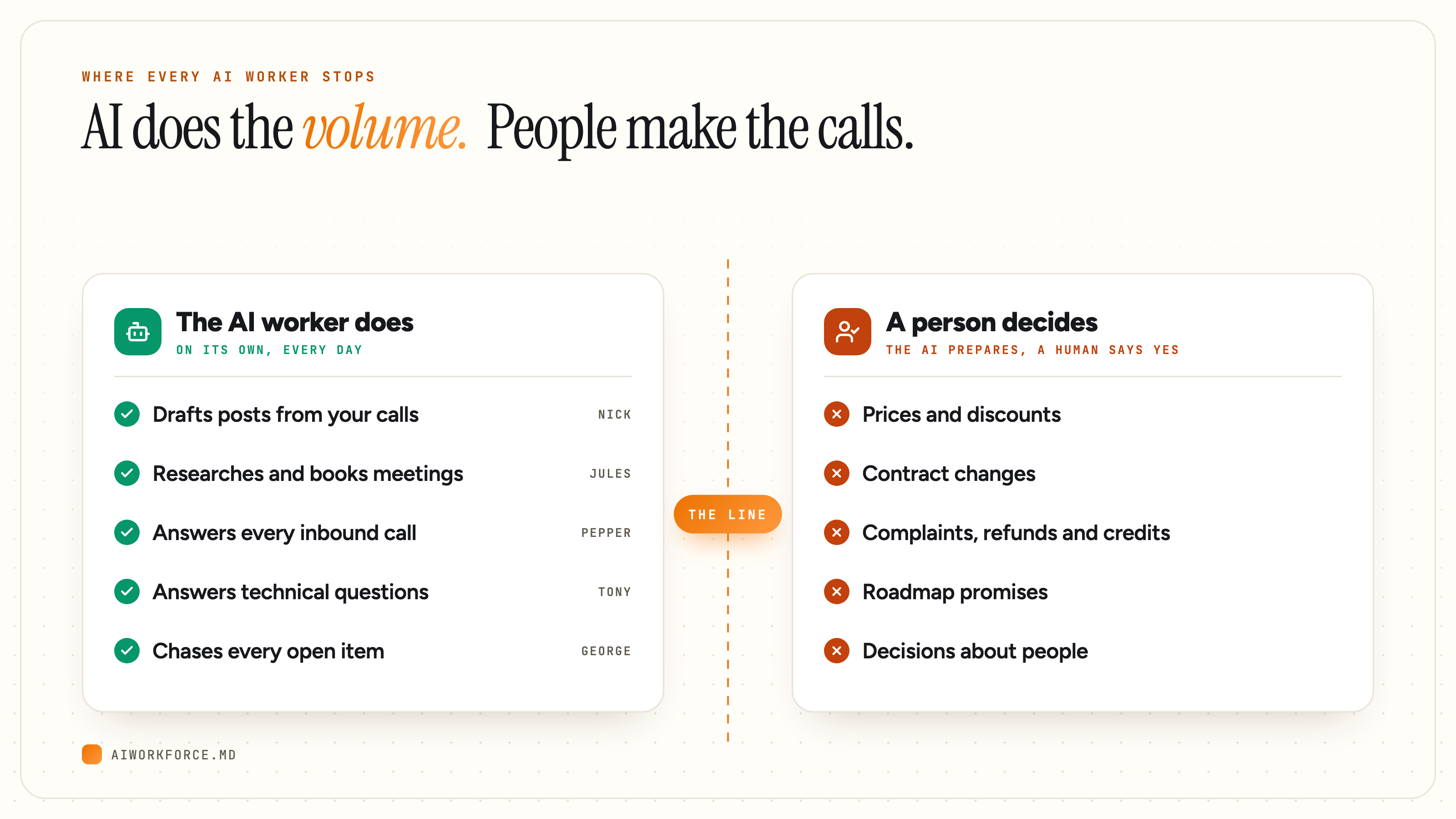
In 2026 an AI worker can own recurring, rules-based work that runs on your own material: turning calls into content, building and researching prospect lists, answering inbound calls, covering technical questions on sales calls, and chasing onboarding tasks. What it shouldn't do is anything that sets a price, changes a contract, makes a promise you can't take back, settles a complaint or makes a decision about a person. Those go to a human, every time.
In this guide you'll get:
A one-table map of what AI workers do on their own and what they hand to a person
Five real jobs, with each worker's actual boundaries
The seven things no AI worker should do, whatever the vendor says
A four-question test to decide whether a task belongs to AI at all
If you're new to the term, start with AI Workers vs. AI Agents vs. AI Tools. If you've already hired one, How to Manage an AI Worker covers the day-to-day.
The quick map: what they do, and what they hand over
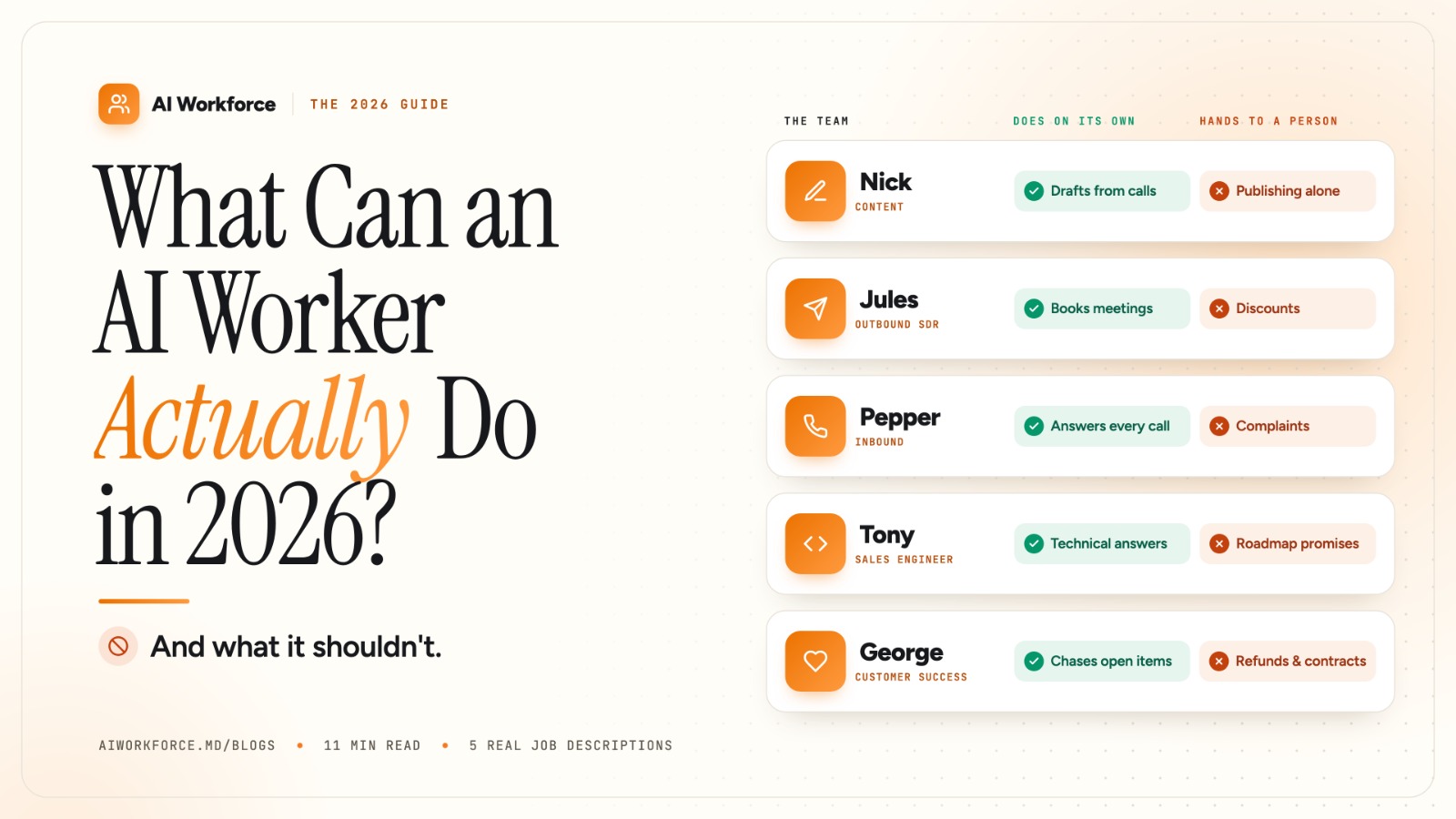
These are the five jobs AI Workforce staffs today. The last column matters as much as the second.
Job | Does on its own | Hands to a person | Reports to |
|---|---|---|---|
Content marketer (Nick) | Reads call transcripts, finds the quotable lines, drafts posts and newsletters, keeps the calendar | Publishing (only after approval), and anything about pricing, customers or legal | Marketing lead |
Outbound SDR (Jules) | Builds and dedupes lists, researches every account, writes sequences, handles replies, books meetings | Discounts, pricing commitments, and the deal once a meeting is booked | Sales lead |
Inbound handler (Pepper) | Answers calls in seconds, qualifies against your criteria, books meetings, logs a summary | Payments, complaints and urgent calls | Revenue lead |
Sales engineer (Tony) | Joins Zoom, Meet or Teams calls, runs discovery, answers technical questions from your docs, sends follow-ups | Roadmap promises, custom pricing and security reviews | Sales engineering lead |
Customer success (George) | Turns contracts into onboarding plans, chases open items, flags renewals, writes health notes | Contract edits, refunds and credits | Customer success lead |
Notice the pattern. Every worker does the volume. Every worker stops at money, commitments and upset customers.
What AI workers are good at in 2026
Strip away the job titles and the work AI handles well has five things in common.
1. It repeats. The same kind of task, every day or every week. Reading calls, researching accounts, answering the phone. AI gets more useful the more often it does the same job, because your edits and feedback build up.
2. It runs on material you already have. Transcripts, your CRM, your docs, your past posts. Nick has a rule that sums this up: no claim without a transcript line behind it. When an AI worker has a source, it's reliable. When it has to guess, it isn't.
3. The rules can be written down. "Qualify against these five questions." "Dedupe against the CRM." "Chase every open item after 48 hours." If you could hand the rules to a new hire on one page, an AI worker can follow them.
4. A mistake can be caught or undone. A draft that waits for approval. A CRM note you can edit. A meeting you can move. That's very different from a refund that's already been paid.
5. You can count the result. Drafts approved, meetings booked, calls answered, items closed. If you can't measure it, you can't tell whether the worker is helping.
When a task has all five, give it to an AI worker. When it's missing two or more, keep a person on it.
Five jobs AI workers actually do today
Here's what each job looks like in practice, taken from each worker's own job description.
Content marketer: Nick
The job: turn what your founders say on calls into content, drafted in their voice.
What he does: reads every sales and meeting transcript, pulls out the lines only your team could have said, proposes angles, drafts LinkedIn posts and newsletters, checks them against the transcript and your style guide, and keeps the editorial calendar. Once a human approves a draft, he schedules it.
Where he stops: he publishes to LinkedIn only, and only after approval. Anything about pricing, named customers or legal matters goes to a person before it's even drafted.
Measured on: drafts ready per week, approval rate, posts published, replies started.
Outbound SDR: Jules
The job: keep the pipeline full without sending lazy templates to everyone.
What he does: builds prospect lists from your ideal customer profile, removes duplicates against your CRM, writes a short research brief on every person before a word is written, drafts multi-step sequences that a second reviewer checks against your rules, handles the replies and books the meeting. Every touch is logged to the CRM.
Where he stops: no discounts and no pricing commitments. Once a meeting is booked, a human rep takes over.
Measured on: contacts reached, reply rate, meetings booked, pipeline created.
Inbound handler: Pepper
The job: make sure no inbound call goes to voicemail.
What she does: answers in seconds, day or night, in a voice you've approved. She asks your qualification questions in order, records the answers honestly, and either books a meeting on the right calendar or routes the caller to the right person with context. A summary and the recording land in your CRM and Slack.
Where she stops: no payments over the phone. Complaints go straight to a human, and so do urgent calls.
Measured on: answer time, qualified leads, meetings booked, calls routed.
Sales engineer: Tony
The job: give every deal technical support, not just the ones your one sales engineer can reach.
What he does: joins Zoom, Meet or Teams calls, maps the prospect's stack and constraints, answers technical questions from your own knowledge base, demos live, and sends an answer log and follow-up note the same day. He also says plainly when something isn't supported.
Where he stops: no roadmap promises and no custom pricing. Security reviews are flagged to a human.
Measured on: calls covered, questions answered, follow-ups sent, time to technical win.
Customer success: George
The job: make sure nothing a customer was promised goes quiet.
What he does: reads the signed contract, builds the onboarding checklist from what was agreed, books the kickoff, chases every open item on both sides, writes a weekly health note that explains the score, and starts preparing renewals 90 days out.
Where he stops: no contract edits, and no refunds or credits.
Measured on: time to onboard, open items closed, renewals flagged, health score coverage.
Each of these job descriptions is public. You can read Nick's, Jules's, Pepper's, Tony's and George's in full.
Seven things an AI worker shouldn't do
This list is where good AI workers and risky ones part ways. None of these are about what the technology can't do. Most AI could attempt every one of them. They're about what it shouldn't do without a person.
Set prices or offer discounts. Pricing is a business decision with a margin attached. An AI that can discount to close a deal will.
Change or interpret contracts. Reading a contract to build an onboarding plan is fine. Editing one, or telling a customer what a clause means for them, isn't.
Settle complaints, refunds or credits. An upset customer needs to feel heard by a person, and money that's been paid out is hard to get back.
Promise what the product will do next. Roadmap promises turn into commitments the moment a prospect writes them down.
Publish or send anything public without a yes, at least until it has earned that trust in a narrow, routine area.
Make decisions about people. Hiring, firing, performance and promotion should stay with humans. The EU AI Act treats AI used for those decisions as high-risk for a reason.
State something it can't source. If a fact isn't in a transcript, a doc or your CRM, the worker should say "I don't know" or ask, not fill the gap.
The rule of thumb: if it involves money, a commitment, an upset customer or a person's job, an AI worker prepares the work and a human makes the call.
"Can't" versus "shouldn't"
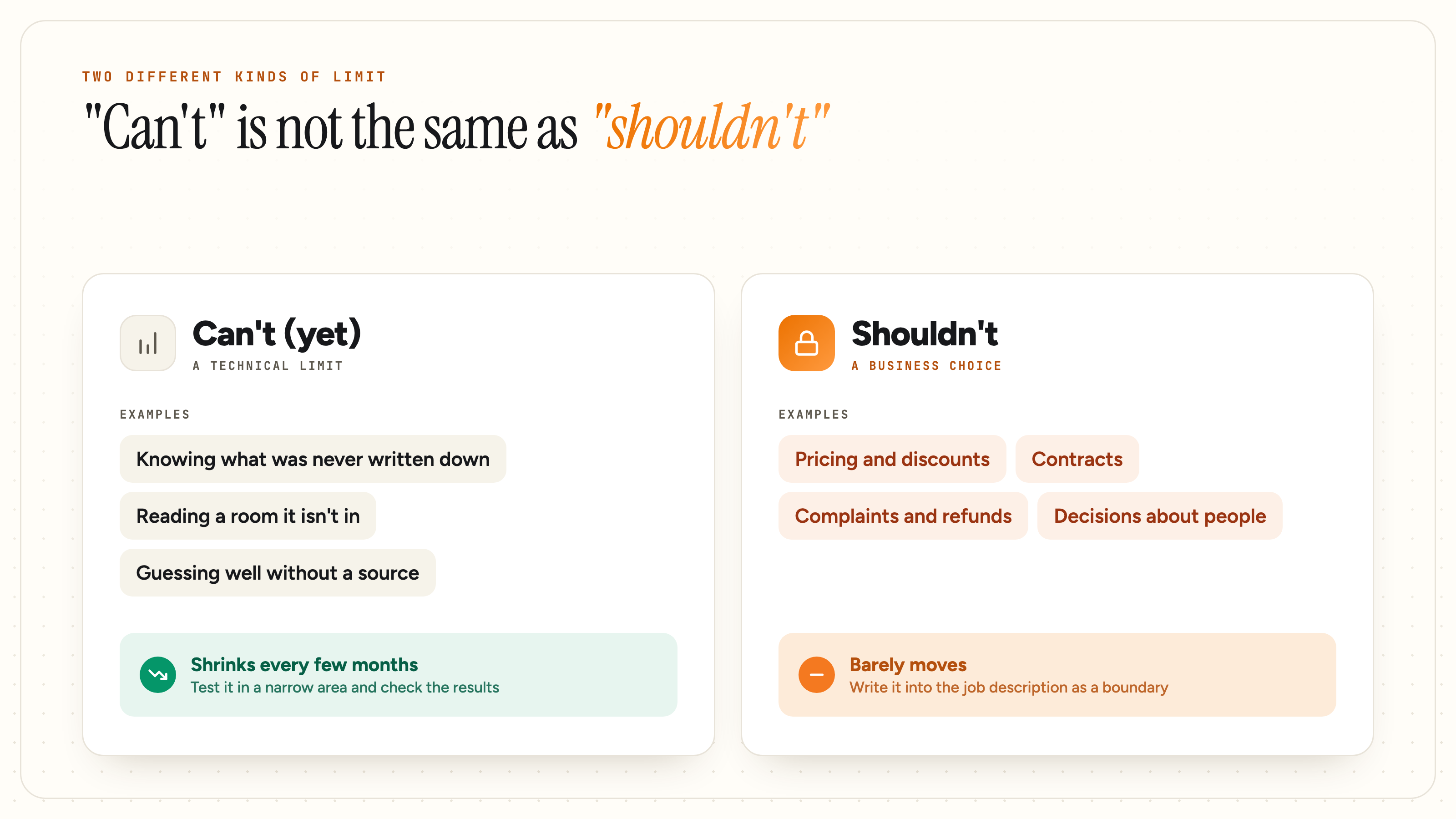
It helps to separate the two, because they change at different speeds.
Can't (yet) | Shouldn't | |
|---|---|---|
What it means | The technology isn't reliable enough for the task | The task needs human judgement or accountability |
Examples | Knowing things that were never written down; reading a room it isn't in | Pricing, contracts, complaints, decisions about people |
Will it change? | Yes, quickly. This list gets shorter every few months | Rarely. These are business choices, not technical limits |
What to do | Test it in a narrow area and check the results | Write it into the job description as a boundary |
Vendors love to talk about the first column shrinking. The second column is the one that protects your business, and it's your call, not theirs.
A four-question test for any task
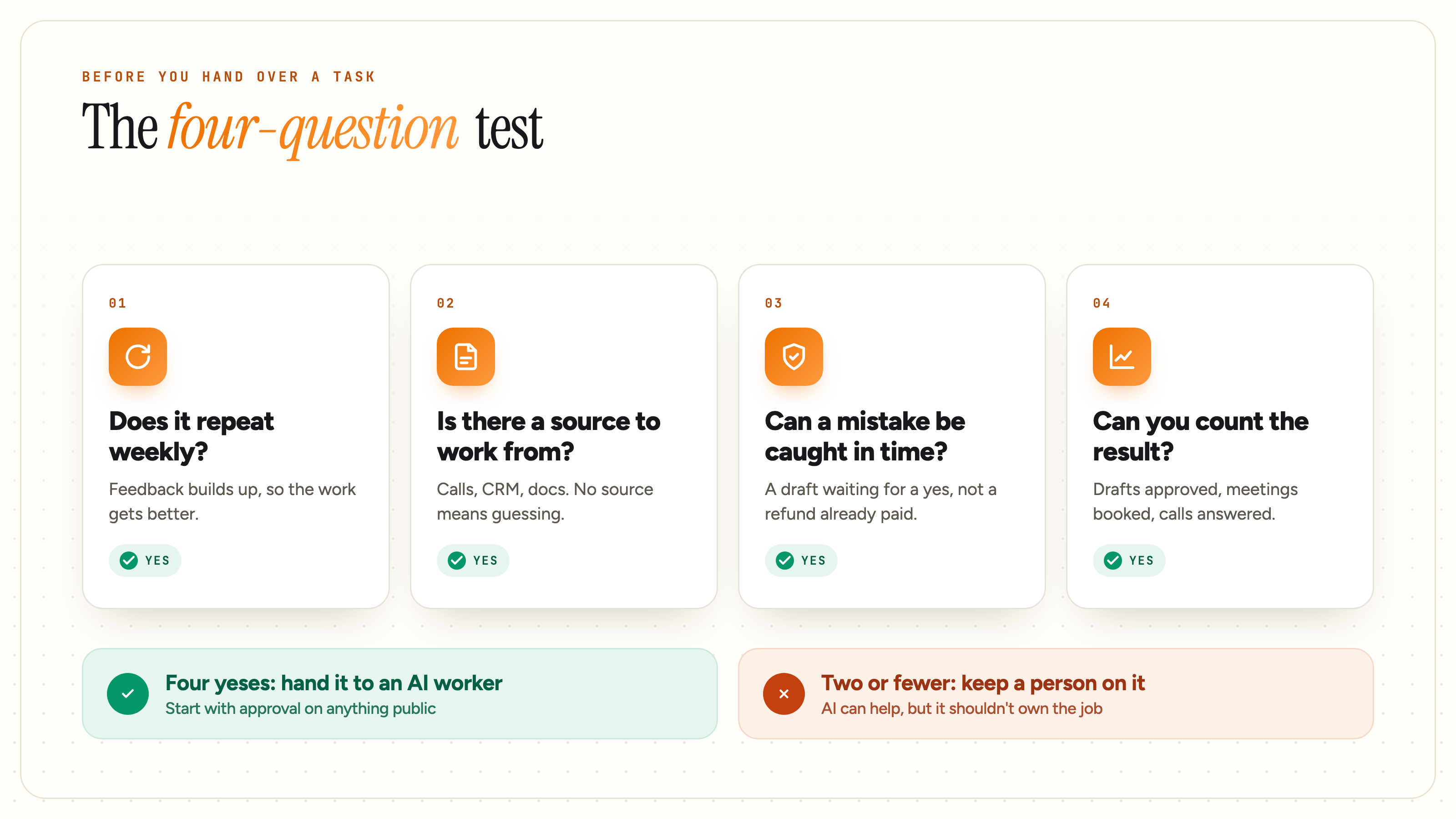
Before you hand something to an AI worker, ask:
Four yeses: hand it over, with an approval step to start. Two or fewer: it's a job for a person, with AI helping at most.
The grey zone moves, and that's fine
Some tasks start in "ask first" and earn their way to "act alone." Publishing a routine post, sending a second follow-up email, rescheduling a meeting. That's normal, and it's how you'd treat a new hire too.
The way to do it is slowly and on the record. Start with nearly everything needing approval. Then, when the approval rate is high and the edits are small, move one routine action at a time to "acts alone." We walk through the green, amber and red system in How to Manage an AI Worker.
What doesn't move is the "shouldn't" list. A worker that's been perfect for six months still doesn't set prices.
One more rule for 2026: say it's AI
If an AI worker talks to people outside your company, like answering calls or sending emails, those people should know they're dealing with AI. That's good manners, and in the EU it's the law: Article 50 of the EU AI Act says AI systems built to interact with people must make that clear to them.
In practice, that means a greeting that says so, a signature that says so, and an easy way to reach a person.
Common misconceptions
"If it can do the task, it should."
Capability isn't the test. Accountability is. AI can write a refund approval in a second. That doesn't mean it should send one.
"AI workers are only for big companies."
It's usually the other way round. Small teams have the most jobs nobody owns, like posting every week, answering every call and chasing every onboarding task.
"Boundaries make AI workers less useful."
They make them usable. A worker without boundaries is one you can't trust near customers, so it ends up doing nothing important.
FAQ
What can an AI worker do in 2026?
AI workers can own recurring, rules-based jobs that run on your own material, such as turning calls into content, building and researching prospect lists, answering inbound calls, covering technical questions on sales calls and chasing customer onboarding tasks.
What shouldn't an AI worker do?
An AI worker shouldn't set prices, offer discounts, edit contracts, settle complaints or refunds, make roadmap promises, make decisions about people, or state facts it can't source. It should prepare that work and hand the decision to a human.
Can an AI worker talk to customers?
Yes, within limits. AI workers can answer calls, reply to prospects and chase onboarding items, as long as people know they're dealing with AI, anything consequential goes to a person and there's an easy way to reach a human.
Can an AI worker replace an employee?
It's better to think of it as filling a job nobody currently owns. AI workers handle the repeatable volume, and they report to a human lead who keeps the judgement calls.
How do I know if a task is right for an AI worker?
Check four things: it repeats at least weekly, there's source material to work from, mistakes can be caught before they matter, and the result can be measured. If all four are true, it's a strong candidate.
How much does an AI worker cost?
At AI Workforce, Nick and Pepper are $499 a month, Jules is $1,500 a month, and Tony and George are priced to the job. Every worker has a 15-day free trial. See pricing.
The bottom line: give it the work, keep the calls
Go back to the two groups of founders. The first group is leaving real work on the table: calls nobody turns into posts, leads nobody calls back, onboarding tasks nobody chases. The second group is one discount, one bad promise or one mishandled complaint away from deciding AI doesn't work.
The answer sits in between, and it's simple enough to write on one line: AI workers do the volume. People make the calls.
If you want to put that into practice this week:
Pick one job that keeps slipping. Content, outbound, inbound, technical questions or onboarding.
Run it through the four questions. Repeats, has a source, mistakes can be caught, results can be counted.
Write the boundaries down first. Money, commitments, complaints and people decisions go to a human.
Name the person it reports to. One person, not a team.
Do that and you'll get the part of AI that actually helps, without the part that keeps founders up at night.
Start with the job that's slipping. Meet the team: Nick (content), Jules (outbound), Pepper (inbound), Tony (sales engineering) and George (customer success). Then start a 15-day free trial with your work email, upload one meeting, and judge the work yourself.