AI Worker
AI Workers vs. AI Agents vs. AI Tools: A Plain-English Guide
What's the difference between AI workers, AI agents and AI tools? Compare what each does, who's accountable, and which one your team actually needs.
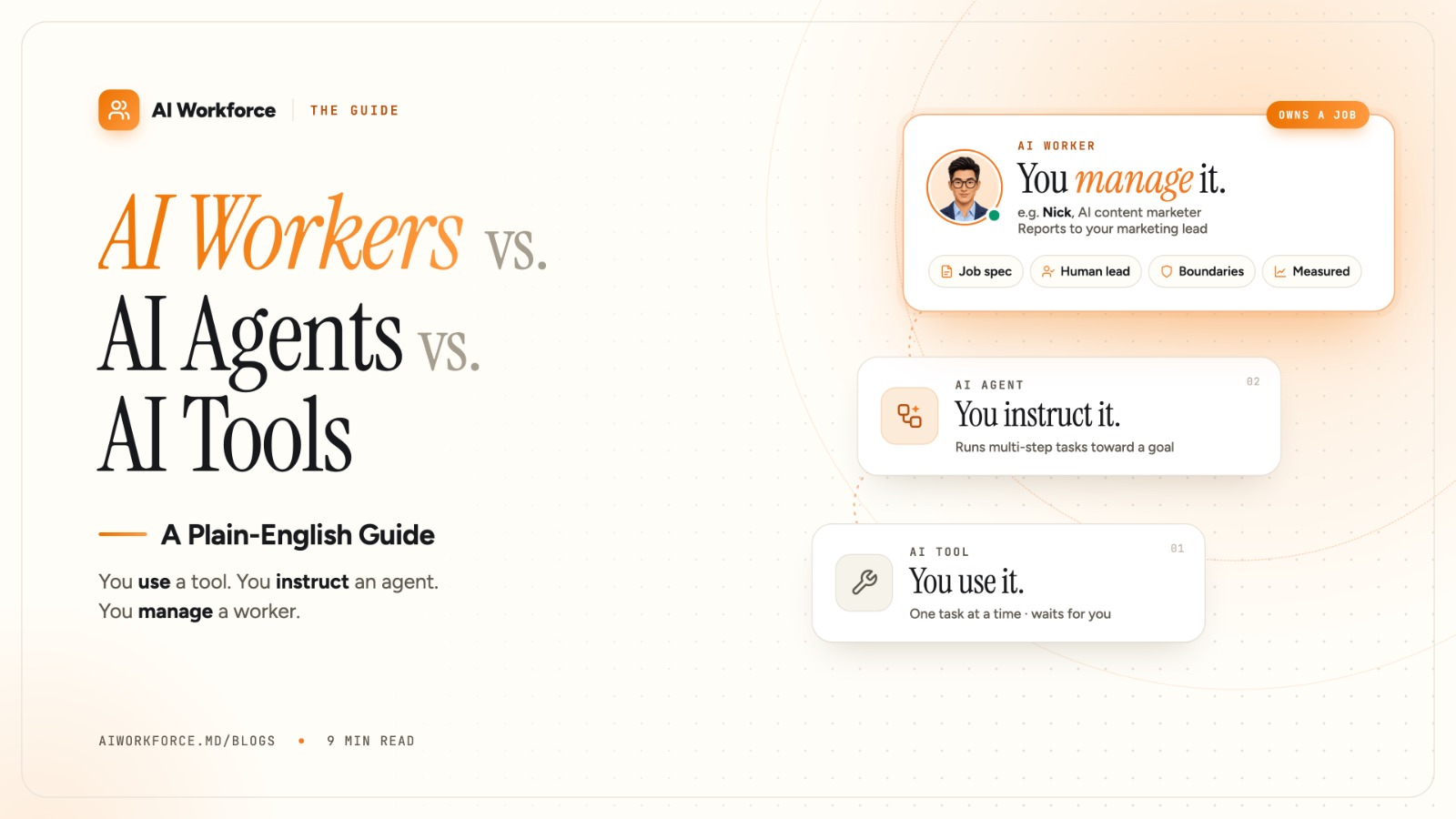
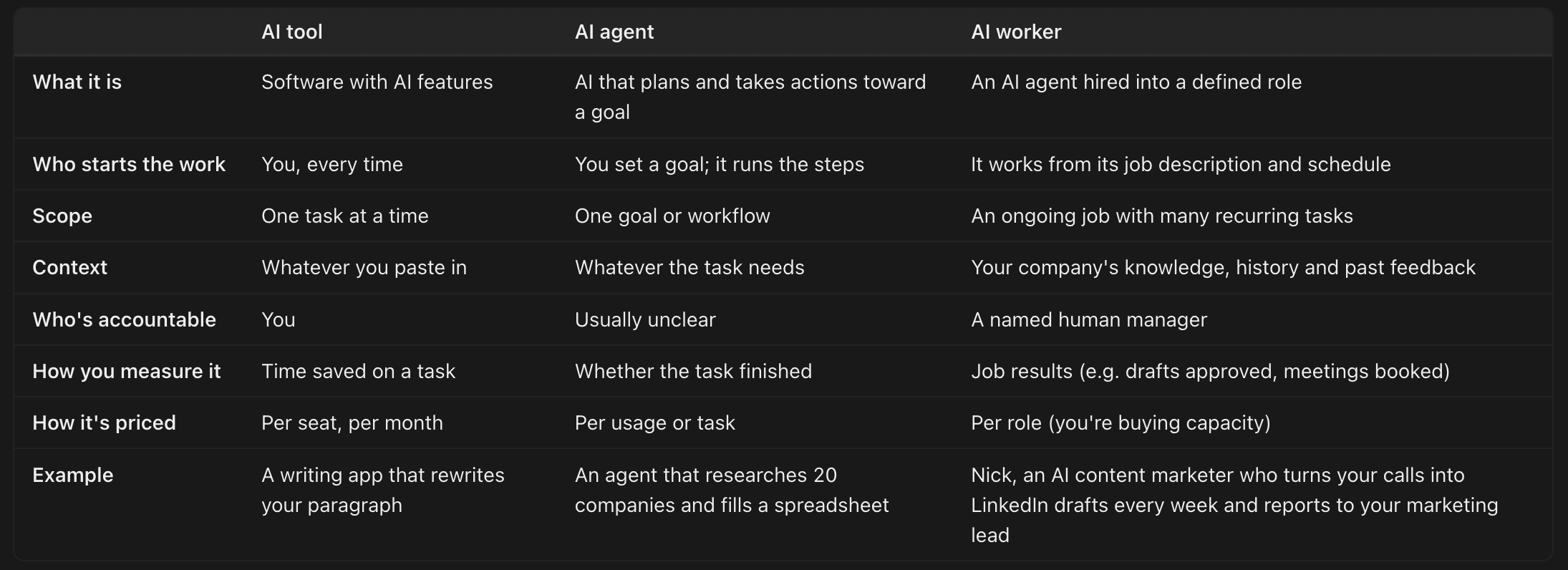
Put simply, you use a tool, you instruct an agent, and you manage a worker.
That last difference matters more than it sounds. It decides who owns the outcome, how much of your time the AI saves, and whether you can trust it near your customers.
The difference at a glance
What is an AI tool?
An AI tool is software where AI makes a single task faster: summarising, rewriting, generating an image, transcribing a call. You decide what to do, when to do it, and what happens with the result.
Good for: quick, one-off help. Drafting an email, cleaning up notes, brainstorming headlines.
The limit: the tool waits for you. If you forget to open it, nothing happens. That's why many teams pay for a dozen AI subscriptions and still feel the work hasn't moved. The tool made each task faster, but nobody owns the job.
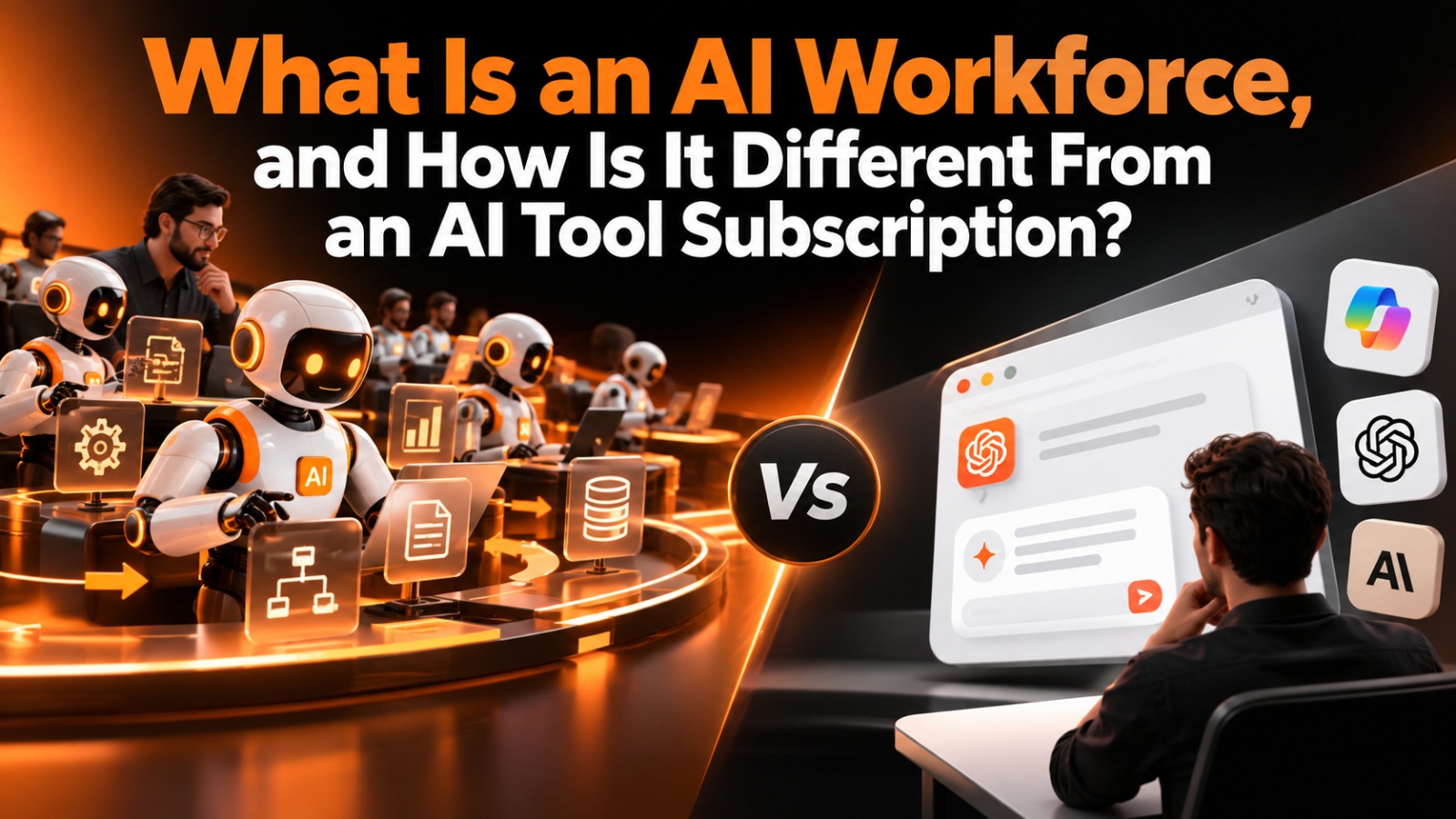
We go deeper on this in What Is an AI Workforce, and How Is It Different From an AI Tool Subscription? (https://aiworkforce.md/blogs/what-is-an-ai-workforce-and-how-is-it-different-from-an-ai-tool-subscription)
What is an AI agent?
An AI agent is AI that can plan and carry out a sequence of steps toward a goal, using other tools along the way. You say "research these 20 companies and summarise their pricing," and it searches, reads, compares and writes the summary without you guiding each step.
Good for: multi-step tasks that follow a clear goal, like research, data entry across systems, or first-pass analysis.
The limit: an agent knows what to do, but nobody has defined whose job it is. Without a role, boundaries and someone accountable, agents tend to become experiments that never turn into reliable work.
That's not just our view. Gartner predicts that over 40% of agentic AI projects will be cancelled by the end of 2027 because of rising costs, unclear business value or inadequate risk controls. It also warns about "agent washing," where existing products are rebranded as agents (Gartner, June 2025: https://www.gartner.com/en/newsroom/press-releases/2025-06-25-gartner-predicts-over-40-percent-of-agentic-ai-projects-will-be-canceled-by-end-of-2027).
What is an AI worker?
An AI worker is an AI agent with a job, not just a task. In practice it has five things a plain agent doesn't:
1. A job description: what it's responsible for, written down.
2. A human manager: a named person who approves its work and is accountable for it.
3. Boundaries: what it may and may not do, and which decisions it must hand to a person.
4. Knowledge of your business: your positioning, product, past work and conversations, not just a prompt.
5. Measures: the results it's judged on, reported regularly.
Here's a real example. This is part of the job description for Nick, our AI content marketer:
Purpose: Keep a steady stream of credible content going out in your founders' voice
Responsibilities: Reads call transcripts, drafts posts and newsletters, holds an editorial calendar
Boundaries: Publishes to LinkedIn only, and only after a human approves the draft
Human manager: Your marketing lead approves the calendar and each draft
Measures: Drafts ready per week, approval rate, posts published, replies started
Exceptions: Anything about pricing, customers or legal goes to a human before it's drafted
These five things are what make an AI worker trustworthy and measurable. Without them, an agent is still an experiment. With them, you can review it the way you'd review any hire.
Where do AI assistants fit?
"AI assistant" usually means a chat-based helper that answers questions and drafts things when you ask. Assistants are reactive: you prompt, they respond, they wait.
In this guide, an assistant behaves like an AI tool you talk to. Some assistants can now take actions too, which moves them towards being agents. The test is the same: does it wait for you, or does it own a job?
Four questions that tell them apart
If you're looking at a product and can't tell which it is, ask:
1. Who starts the work? If it's always you, it's a tool.
2. Can it finish a multi-step task without you? If yes, it's at least an agent.
3. Is a named person accountable for its output? If yes, it's closer to a worker.
4. Is it measured on job results, reported regularly? If yes, it's a worker.
One task, three ways: turning a sales call into a LinkedIn post
With an AI tool:
You remember a good line from Tuesday's call. You find the recording, copy the transcript, paste it into a writing tool, prompt it, edit the draft, and post it. It takes about an hour, and only happens if you remember.
With an AI agent:
You tell an agent, "Turn Tuesday's call into a LinkedIn post." It reads the transcript and writes a draft. That's better, but you still had to remember the call, start the task, and judge whether the draft sounds like you. Next week, you start from scratch.
With an AI worker:
Nick reads every call transcript your team shares, flags the lines worth posting, drafts them in the founder's voice, and puts them on the calendar. Your marketing lead approves or edits each one, and the edits teach the next draft. Nothing is published without approval. On Friday, Nick sends a note on what shipped.
Same AI underneath. The difference is who owns the work.
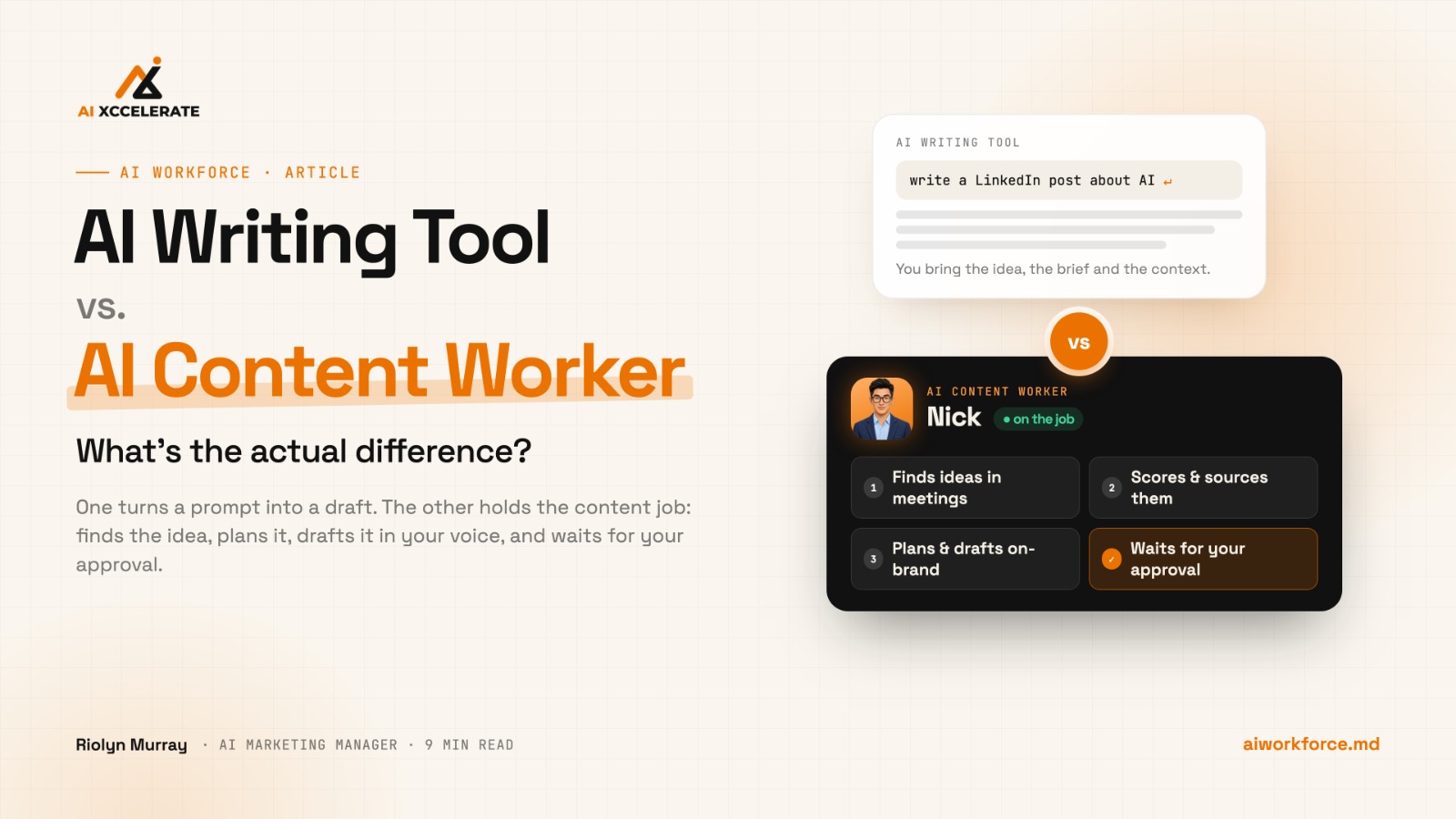
More on this in AI Writing Tool vs. AI Content Worker: What's the Actual Difference? (https://aiworkforce.md/blogs/ai-writing-tool-vs-ai-content-worker-what-s-the-actual-difference)
Which one do you need?
Choose an AI tool if:
- The task is occasional and you're happy to drive it yourself.
- You mainly want individual people to work faster.
Choose an AI agent if:
- You have a clearly defined, multi-step task.
- You or your team can build, monitor and maintain it.
Choose an AI worker if:
- A job keeps slipping because nobody has the time to own it, like content, outbound, inbound follow-up or customer success.
- You want results you can measure, not just faster tasks.
- You need clear boundaries and a human approving anything consequential.
Most small teams end up with a mix: tools for individual productivity, and a few AI workers for the jobs that matter but never get done consistently.
How to judge an AI worker before you commit
Treat it like a probation period for a new hire. In the first two weeks, check:
- Does it have a written job description and boundaries? If the vendor can't show you one, it's an agent with a new label.
- Who approves its work? There should be a named human lead and an approval step for anything public or consequential.
- What does it know? It should work from your material (calls, docs, past work), not generic prompts.
- What does it report? Look for a regular summary of what it did and what it achieved.
- Do the numbers improve? For a content worker, the share of drafts you approve should rise over the trial.
Every AI Workforce worker comes with a 15-day free trial (https://aiworkforce.md/pricing) so you can run exactly this test.
Common misconceptions
"AI workers replace people."
The useful ones fill jobs that aren't getting done, and they report to a person. Nick doesn't replace a marketing lead. He gives that lead a content marketer they didn't have.
"An agent and a worker are the same thing."
The technology can be similar. The difference is the job description, manager, boundaries and measures around it, and that's what decides whether it delivers value or gets cancelled.
"Workers act without oversight."
A well-designed worker asks before anything consequential. Ours publish nothing, send nothing sensitive, and decide nothing about pricing or legal matters without a human.
FAQ
What is the difference between an AI agent and an AI worker?
An AI agent can carry out multi-step tasks toward a goal. An AI worker is an agent placed in a defined job, with a job description, a human manager, boundaries and measurable results.
What is the difference between an AI agent and an AI assistant?
An AI assistant responds when you ask and then waits. An AI agent can plan and complete a sequence of steps toward a goal without being guided through each one.
Is ChatGPT an AI agent?
In everyday use, ChatGPT works as an AI assistant: it responds to your prompts. Some features let it take multi-step actions, which is agent-like behaviour. It isn't an AI worker, because it has no job, manager or measured responsibilities inside your business.
Are AI workers the same as AI employees?
They describe the same idea: AI that holds a role rather than just helping with tasks. "AI worker" is the clearer term, because the AI is managed by people rather than employed in their place.
How much does an AI worker cost?
Prices vary by role and capacity, typically from a few hundred to a few thousand dollars a month. At AI Workforce, Nick (content) and Pepper start at $499 a month, Jules (outbound) is $1,500 a month, and every worker has a 15-day free trial. See pricing: https://aiworkforce.md/pricing
Can an AI worker work without supervision?
It can do the day-to-day work on its own, but a good AI worker still has a human manager who approves consequential actions, like publishing content or contacting customers.
The bottom line
Tools make tasks faster. Agents finish tasks. Workers own jobs. If something important keeps slipping because nobody has time to own it, you need more than a faster tool. You need someone accountable for doing it, and an AI worker with a clear job and a human manager can be that someone.
Meet the team: Nick (content), Jules (outbound), Pepper, Tony (sales engineering) and George (customer success). Start a 15-day free trial with your work email and judge them on the numbers.
Nick: https://aiworkforce.md/workers/nick
Jules: https://aiworkforce.md/workers/jules
Pepper: https://aiworkforce.md/workers/pepper
Tony: https://aiworkforce.md/workers/tony
George: https://aiworkforce.md/workers/george
Start your free trial: https://app.aiworkforce.md/signup